A single IT employee leaves, and suddenly nobody knows who renews the firewall license, where the backup reports go, or why the file server has been slowing down for months. That is often when the internal IT versus MSP question stops being theoretical. For a small or midsize Atlanta organization, it becomes a business continuity decision.
The right answer is not always “outsource everything.” Some organizations need an internal technology leader. Others need dependable day-to-day coverage without the cost and risk of building a full department. Many get the best result from a practical mix of both.
Internal IT Versus MSP: Start With the Work
The most useful comparison is not employee versus vendor. It is the work your organization needs done, how consistently it must be done, and what happens when it is missed.
Internal IT is often strongest when technology is central to the way your organization operates. A growing company with custom applications, several locations, specialized equipment, or complex workflows may need someone inside the business who understands the people, priorities, and operational details every day. An internal IT manager can sit in leadership meetings, coordinate office moves, guide application decisions, and translate business needs into technology plans.
But one capable IT person is not a complete IT department. They cannot be available around the clock, handle every help desk request, manage vendors, test backups, patch systems, monitor security alerts, document the network, and plan for the future without trade-offs. When they take vacation, get sick, or leave, their knowledge can leave with them.
An MSP provides a team, a defined service process, and a broader toolset for a predictable monthly cost. That can include monitoring, patching, endpoint protection, backups, help desk support, security review, vendor coordination, and strategic guidance. The point is not to create more tickets or more meetings. It is to catch problems early and keep routine IT work from depending on one person’s memory.
Where Internal IT Has the Advantage
An internal team has direct proximity to the business. They can walk the floor, see how staff actually use systems, and respond to changing priorities without needing an outside provider to learn the context. For organizations with a large number of users, frequent on-site needs, or highly specialized technology, that familiarity matters.
Internal IT can also be the better fit when your company needs someone to own technology strategy full time. If you are integrating acquisitions, building proprietary software, running a major internal systems project, or managing a complex data environment, a dedicated internal leader may be essential.
There is also a cultural advantage. A good internal IT professional knows which partner struggles with remote access, which attorney needs secure mobile workflows, and which executive will call immediately if the conference room display fails. That knowledge is valuable.
The catch is capacity. A small internal team may spend most of its week resetting passwords, setting up new laptops, chasing printer problems, and responding to urgent requests. Important work such as vulnerability management, disaster recovery testing, documentation, and long-term planning gets pushed to “when things slow down.” They rarely do.
Where an MSP Makes More Sense
An MSP is usually the stronger option when your organization needs broad IT coverage but does not need, or cannot justify, a full internal department. For many businesses with 15 to 150 employees, hiring for every specialty is unrealistic. Security, cloud administration, Microsoft 365 management, network engineering, compliance support, and backup recovery are different disciplines.
With a well-run managed services provider, those capabilities are available without recruiting and retaining several full-time specialists. You should also gain process discipline: documented assets, regular patching, monitored backups, security baselines, response procedures, and a roadmap tied to real risks.
That is particularly relevant for law firms, healthcare-adjacent practices, nonprofits, and congregations. These organizations may not have enterprise IT budgets, but they still hold confidential information and face serious consequences if systems are unavailable or data is exposed. A ransomware event does not care whether your staff size is 20 or 2,000.
The best MSP relationships are proactive. If the first time you hear from your provider is after the server is down, you are buying remote break-fix support with a monthly invoice. Managed IT should include someone reviewing what is aging, what is vulnerable, what is not backed up properly, and what needs to be addressed before it turns into an emergency.
Cost Is More Than Salary
A common mistake is comparing an internal IT salary to an MSP monthly fee and stopping there. Salary is only one part of the cost.
A full-time hire also comes with benefits, payroll taxes, training, tools, coverage during absences, recruiting time, and the risk of turnover. You may still need outside expertise for penetration testing, compliance projects, major network work, or after-hours incidents. A lower salary can become expensive if that person is overloaded and critical maintenance falls behind.
On the MSP side, a low monthly quote is not automatically a bargain. Ask what is actually included. Are security tools, backup monitoring, after-hours support, on-site visits, Microsoft 365 administration, project labor, and strategic planning covered? Are there limits that turn routine needs into surprise invoices? Does the provider explain exclusions clearly, or are you expected to figure it out after signing?
Predictability matters, but so does accountability. You want a provider that can tell you what is covered, what is not, and why a recommended investment reduces a specific business risk.
The Hybrid Model Is Often the Practical Answer
For organizations that already have internal IT, outsourcing does not have to mean replacing that person. In fact, an MSP can make an internal IT leader far more effective.
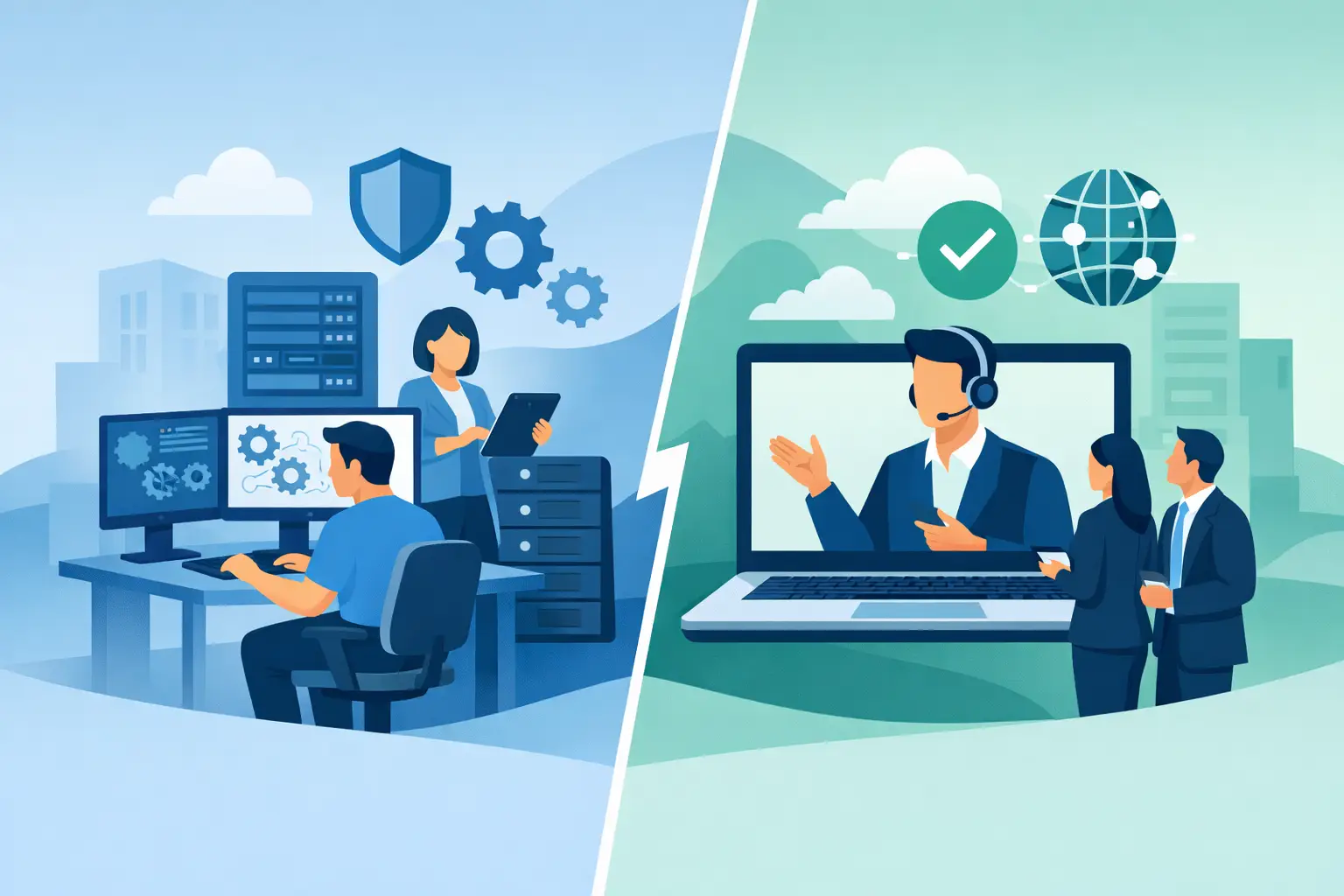
Your internal resource can focus on staff relationships, business applications, executive priorities, and projects that require organizational context. The MSP can provide help desk depth, security monitoring, patch management, backup oversight, documentation, escalation support, and additional hands for large projects. Instead of one person being expected to know everything, the work is divided according to who is best positioned to do it.
This model is especially useful when an internal IT manager is stretched thin or when the organization is growing faster than its technology support. It also reduces the operational risk of a single point of failure. If your internal expert is unavailable, another knowledgeable team can still access current documentation and keep core systems moving.
A hybrid arrangement only works if responsibilities are clear. Who owns user onboarding? Who handles vendor escalation? Who approves changes? Who reviews security alerts? Who tests recovery? Vague handoffs create delays and finger-pointing. Good partners document the boundaries, communicate directly, and care more about fixing the problem than winning the argument.
Questions to Ask Before You Decide
Before hiring or outsourcing, look honestly at your environment. Are routine maintenance tasks consistently completed, or only when someone has time? Can you restore a critical file or server from backup, and have you tested it? Do you know which devices have access to sensitive data? Is there a plan if your primary IT person leaves tomorrow?
Then consider the level of support your people expect. If employees regularly need immediate, in-person assistance, an internal presence may be necessary. If most needs can be handled remotely and the bigger concern is consistent security and coverage, an MSP may provide better value.
Finally, evaluate providers the same way you would evaluate an employee. Ask how they communicate during an outage, who answers the phone, how they document your environment, and how often they review risk with leadership. A distant ticket queue is not a technology strategy.
For Metro Atlanta organizations that need a local partner without corporate runaround, 404 Network Ninjas approaches the decision with an assessment first. The goal is to identify what is working, where the risk sits, and whether outsourced support, internal hiring, or a hybrid model will actually solve the operational problem.
The best choice is the one that lets your people do their jobs without wondering whether the network, backups, security controls, or next support call will hold up. Build coverage around the work that cannot be allowed to fail, then choose the team structure that can sustain it.